

If you're a publisher, ad network, or supply-side platform that wants to own your programmatic monetization stack, a white label ad exchange is the right move. Request architecture documentation, QPS benchmarks, and SLA terms from any vendor before signing anything. The core business case is straightforward:
- Margin control: Keep the spread between what buyers pay and what publishers earn, instead of handing it to a third-party exchange.
- Branded relationships: Buyers and sellers transact under your brand, not a vendor's.
- Data ownership: Your bid-stream data, your user signals, your analytics. No leakage to a shared platform.
- Integration control: You decide which demand partners connect, at what priority, and under what terms.
Vendors worth evaluating include Floxis, which runs a full white-label RTB stack with OpenRTB, Prebid.js, Prebid Server, and built-in GDPR/CCPA compliance support.
Table of Contents
- Key technical features every vendor must support
- How does a white label exchange actually run an auction?
- What integrations and ad formats do you need to confirm?
- How do you evaluate and choose the right vendor?
- How Floxis meets the evaluation checklist
- Launch your own branded exchange with Floxis
- Key Takeaways
- The part most operators underestimate
- Useful sources for deeper due diligence
Key technical features every vendor must support
Not every platform that calls itself a white label ad exchange actually delivers production-grade infrastructure. Here is the hard checklist to apply during vendor evaluation.
Protocol and auction support
- OpenRTB 2.5 and 2.6 compliance, including all standard bid request/response fields
- First-price auction semantics with configurable floor enforcement
- Server-side auction capability (no client-side-only solutions for production scale)
Header-bidding compatibility
- Prebid.js adapter support for client-side header bidding
- Prebid Server integration for server-side auction orchestration at scale
- SDK support for mobile in-app inventory (iOS and Android)
- VAST/VPAID support for video, including CTV/OTT environments
Optimization and operational controls
- Real-time auction optimization engine with per-endpoint margin and shaping controls
- Floor price management with dynamic adjustment capability
- Sellers.json and ads.txt support, plus schain object validation for supply chain transparency
- Win/drop audit logs for operational troubleshooting and partner reconciliation
Security and compliance
- Fraud detection and traffic validation (IVT filtering)
- Brand-safety tooling or third-party integration hooks (e.g., DoubleVerify, HUMAN)
- Consent framework support: TCF 2.x for GDPR, GPP for CCPA and US state privacy laws
- Data residency options and user-data handling controls
Stat to know: Industry analysis confirms that white-label exchanges enable publishers and data providers to capture incremental revenue by owning the margin layer that would otherwise flow to a third-party exchange.
How does a white label exchange actually run an auction?
The flow is faster than most people picture. A bid request arrives from a publisher's supply adapter, typically within 10–30 milliseconds of an ad slot loading. The exchange's adapter layer parses and enriches that request, appending user consent signals, schain data, and any floor price logic. The auction engine then fans the request out to connected demand partners simultaneously, collects responses within the configured timeout window, runs the auction, and returns the winning bid to the publisher's ad server or SDK.
Where you place the optimization and margin logic matters. Applying margin at the auction layer, before the winning bid is returned, gives you clean accounting and prevents slippage. Applying it post-auction at the reporting layer creates reconciliation headaches and can erode partner trust if buyers see discrepancies between what they bid and what they're billed.
Pro Tip: Place traffic shaping and margin controls at the adapter layer, not the reporting layer. This way, every demand partner sees a consistent, predictable bid stream, and your margin is captured cleanly at auction time rather than adjusted after the fact.
Server-side vs. client-side
Server-side auctions (via OpenRTB infrastructure or Prebid Server) reduce page-load latency for publishers and give you centralized control over auction logic. Client-side Prebid.js integrations are faster to deploy but put auction orchestration in the browser, which limits your ability to apply server-side optimization. Most production deployments use both: Prebid.js for direct publisher integrations and Prebid Server or OpenRTB for high-volume, low-latency demand paths.
Scalability and SLA expectations
Production-grade infrastructure needs to handle thousands of queries per second (QPS) with sub-100ms end-to-end latency. Global clusters across US, EMEA, and APAC regions reduce round-trip time for geographically distributed inventory. Ask every vendor for their documented QPS ceiling, their p99 latency figures under load, and their uptime SLA. Anything below 99.9% uptime is a red flag for a production exchange.
Operational responsibilities don't disappear after launch. Adapter maintenance, demand partner onboarding, monitoring dashboards, and incident response all require ongoing attention. Clarify upfront which of these the vendor handles and which fall to your team.
What integrations and ad formats do you need to confirm?
Gaps in integration coverage are the most common source of post-launch rework. Confirm every item on this list before signing a vendor contract.
Integration endpoints
- OpenRTB server-to-server endpoints for DSP and SSP connections
- Prebid.js adapters for client-side publisher integrations
- Prebid Server modules for server-side demand orchestration
- Native SDKs for iOS and Android in-app inventory
- Reporting APIs for data export to BI tools or internal dashboards
Ad formats and devices
| Format | Protocol/Standard | Devices |
|---|---|---|
| Display (banner) | OpenRTB banner object | Desktop, mobile web |
| Native | OpenRTB native object | Desktop, mobile web, in-app |
| Video (instream) | VAST 4.x / VPAID | Desktop, mobile web |
| Mobile in-app | OpenRTB + SDK | iOS, Android |
| CTV/OTT | VAST 4.x | Connected TV, streaming devices |
| Audio | OpenRTB audio object | Streaming, podcast apps |
Supply chain and consent controls
Ads.txt and sellers.json support are non-negotiable for any exchange that wants to transact with major DSPs. Schain object validation prevents unauthorized reselling. Bid request enrichment (appending user-consent strings, device data, and contextual signals) improves match rates and keeps you compliant with GDPR and CCPA requirements. Confirm that the vendor's platform propagates TCF consent strings and US Privacy strings correctly through every bid request.
Testing infrastructure
Ask for a sandbox environment with test bid streams before committing to a full integration. End-to-end validation tools that let you inspect bid requests and responses in real time will save weeks of debugging during onboarding.
How do you evaluate and choose the right vendor?
Run every vendor through the same scoring framework. Here are the questions that separate production-ready platforms from demo-ware.
- Pricing and contract terms: What is the setup fee? Is pricing per request, per impression, or a flat license? Are there volume tiers? What are the contract exit terms?
- Scalability and performance: What is your documented QPS ceiling? What is your p99 latency under peak load? How many global regions do you operate?
- Integration breadth: Which OpenRTB versions do you support? Do you maintain Prebid.js adapters and Prebid Server modules? Do you have native SDKs for iOS and Android?
- Compliance and data control: How do you propagate TCF consent strings? Do you support data residency requirements? How do you handle CCPA opt-outs?
- Support and onboarding: Do you provide a dedicated onboarding engineer? What does your adapter maintenance SLA look like? Is there a written onboarding playbook?
- Analytics and optimization: Is reporting real-time or delayed? Can I set per-endpoint floor prices and margin targets? Do you provide win/drop audit logs?
Trust signals to require:
- Live production case studies with named metrics (fill rate improvement, eCPM uplift, latency benchmarks)
- Published API documentation and OpenRTB field mapping
- A written onboarding playbook with milestone timelines
- SLA language that specifies uptime percentage and remedies for breach
Red flags that should stop a conversation:
- Opaque or "contact us for pricing" with no structure disclosed
- No reference customers at comparable traffic scale
- Missing audit logs or no access to raw bid-stream data
- Single-region infrastructure with no global failover
- Vague consent handling ("we support GDPR" without specifics)
Running a technical pilot: Measure fill rate, eCPM uplift versus your current monetization baseline, end-to-end latency (p50 and p99), and error rate on bid requests. Run the pilot for at least four weeks to capture weekly demand fluctuations before drawing conclusions.
How Floxis meets the evaluation checklist
Floxis is built specifically for publishers, ad networks, and supply-side platforms that want to operate a branded RTB exchange without building the infrastructure from scratch.
- Prebid.js and Prebid Server support: — Native adapters for both client-side and server-side header bidding workflows, covering the full Prebid ecosystem.
Floxis's product suite covers the full stack: RTB infrastructure, Prebid.js, and Prebid Server, each as a distinct product that can be deployed together or independently depending on your architecture.
Launch your own branded exchange with Floxis
Running your own programmatic exchange means keeping the margin that currently flows to a third-party platform, and Floxis makes that transition faster than building from scratch. Publishers and ad networks that move to a branded RTB stack typically see measurable fill rate and eCPM improvements within the first pilot period, with full operational control from day one.
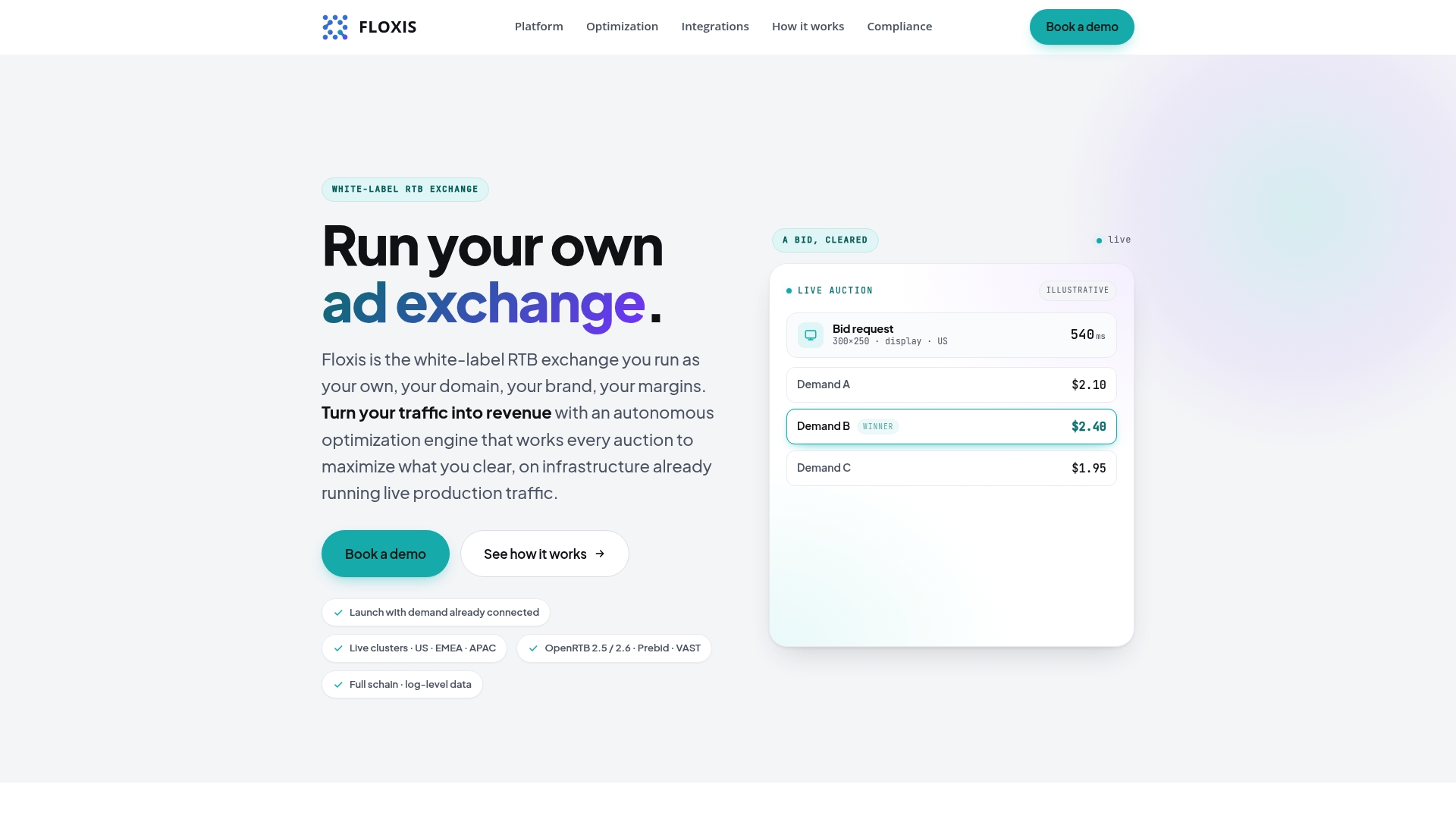
Floxis handles the infrastructure: OpenRTB server-side auctions, Prebid.js and Prebid Server adapters, global clusters, and compliance hooks. Your team handles the relationships. The OpenRTB infrastructure product is the starting point for most deployments. Schedule a 45–60 minute technical discovery call to walk through your architecture, confirm QPS and latency requirements, and get a realistic launch timeline scoped to your inventory.
Key Takeaways
A white label ad exchange is the right infrastructure choice for any publisher or ad network that wants to own programmatic margin, brand its supply relationships, and control its data end to end.
| Point | Details |
|---|---|
| Require OpenRTB and Prebid support | Confirm OpenRTB 2.5/2.6 and both Prebid.js and Prebid Server before signing any vendor contract. |
| Validate QPS and latency SLAs | Ask for documented p99 latency under peak load and a written uptime SLA of at least 99.9%. |
| Insist on privacy and compliance hooks | TCF consent string propagation and CCPA/GPP support must be built into the bid-request flow, not added later. |
| Plan for adapter maintenance | Budget ongoing engineering time for demand partner onboarding and adapter updates after launch. |
| Floxis covers the full stack | Floxis provides white-label RTB, Prebid.js, Prebid Server, global clusters, and managed onboarding in one platform. |
The part most operators underestimate
The technical checklist for a white label ad exchange is well-documented. What catches operators off guard is the operational weight that arrives after launch.
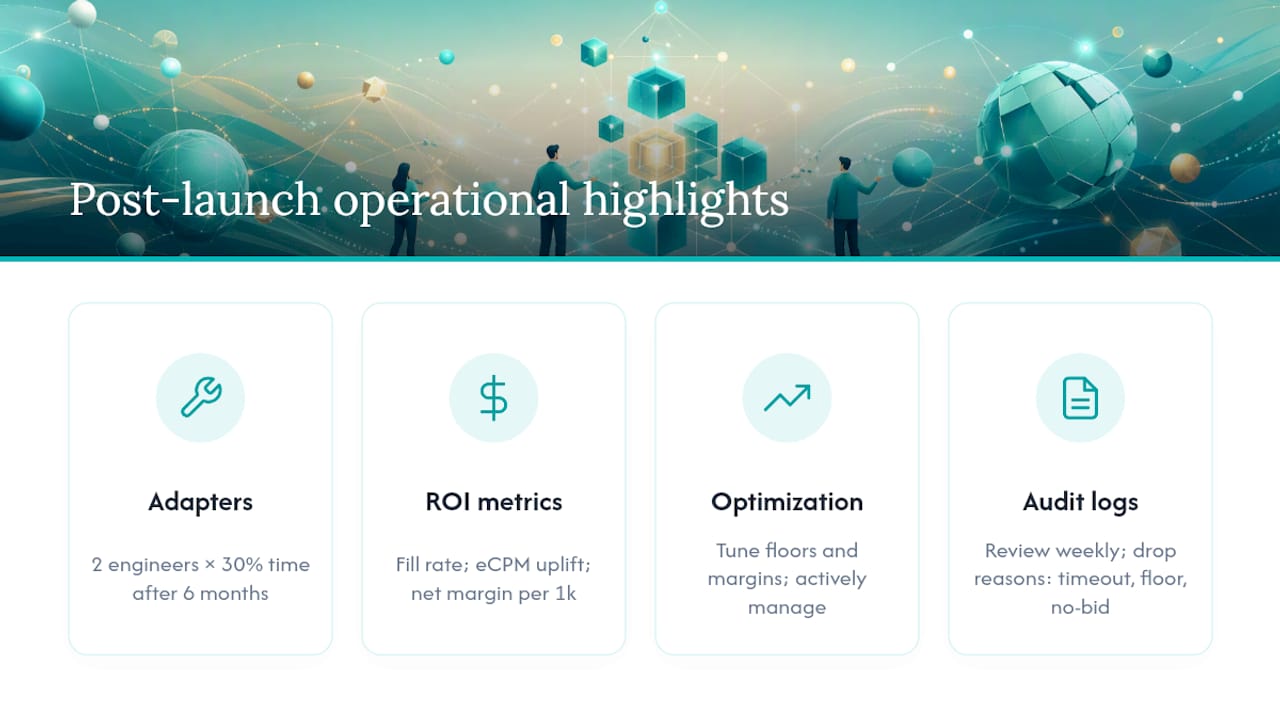
Adapter maintenance is the hidden cost nobody budgets for. Demand partners update their bid protocols, add new fields, deprecate old ones. If your vendor doesn't own adapter maintenance as part of the SLA, that work lands on your engineering team, and it compounds. A platform that looked lean at launch starts to feel expensive six months in when two engineers are spending 30% of their time on adapter upkeep instead of yield optimization.
The ROI framework is also simpler than most operators expect. Track three numbers: fill rate versus your pre-launch baseline, eCPM uplift per format, and net margin retained per thousand impressions. If you're not seeing measurable movement on all three within 60–90 days of full production launch, the problem is almost always in the optimization layer, not the auction engine. Floor prices set too high kill fill rate; margin targets set too aggressively push demand partners to cheaper inventory. The optimization engine is where you tune that balance, and it requires active management, not a set-and-forget configuration.
One operational tip that pays off quickly: build your win/drop audit logs into your weekly review process from day one. Patterns in drop reasons (timeout, price floor, no bid) tell you exactly where to focus demand onboarding and floor price adjustments. Most operators ignore these logs for the first few months and then spend weeks reverse-engineering problems that the logs would have flagged immediately.
Useful sources for deeper due diligence
These are the primary references worth bookmarking during vendor evaluation and implementation planning.
- Floxis - Run your own ad exchange
- OpenRTB Infrastructure — Floxis
- Prebid.js Infrastructure — Floxis
- Prebid Server Infrastructure — Floxis | Server-Side Auction Infrastructure at Scale
- Empowering the Publishers and Data Providers with ...
- policies.google.com
- policies.google.com